
Master Betting Bankroll Management

Most bettors lose money not because they can’t pick winners, but because they lack proper bankroll management — successful wagering requires strategy and discipline beyond game selection. Bankroll management starts with a structured plan for your starting bankroll, including a consistent betting unit (e.g., flat betting 1–2% of your total bankroll) to control risk.
Proper bankroll allocation divides your overall bankroll into units before you wager so you don’t overextend on any single bet and can withstand inevitable losing streaks. Effective bankroll management is the cornerstone that separates long-term profitable bettors from those who ultimately lose their entire bankroll, even if they’re strong handicappers. This guide covers the betting practices and sports betting bankroll management strategies that protect your initial deposit and support sustainable bankroll growth over time.
Spend $5+ Get $150 in Bonus Bets Over 14 Days
Plus Get up to $1,000 Deposit Bonus
Bet on All Your Favorite Sports With America's Top-Rated Sportsbook
Spend $5+ Get $150 in Bonus Bets Over 14 Days
Plus Get up to $1,000 Deposit Bonus
Bet on All Your Favorite Sports With America's Top-Rated Sportsbook
Up to $1,500 in Bonus Bets if Your First Bet Doesn't Win*
*Bonus Bets Expire in 7 Days. One New Customer Offer Only. Add’l terms. 21+. Gambling Problem? Call 1-800-GAMBLER or 1-800-MY-RESET
Up to $1,500 in Bonus Bets if Your First Bet Doesn't Win*
*Bonus Bets Expire in 7 Days. One New Customer Offer Only. Add’l terms. 21+. Gambling Problem? Call 1-800-GAMBLER or 1-800-MY-RESET
Get $250 in Bonus Bets When You Wager $5 for 5 Days ($50 Bonus Bets Per Day)
Available on Desktop, Android & iOS
Easy Deposits, Fast Withdrawals
Get $250 in Bonus Bets When You Wager $5 for 5 Days ($50 Bonus Bets Per Day)
Available on Desktop, Android & iOS
Easy Deposits, Fast Withdrawals
Get a 100% Bet Match up to $100 in FanCash for 10 Days
Earn FanCash & Spend it on Team Swag or More Bets
Daily Odds & Profit Boosts on Select Games
Get a 100% Bet Match up to $100 in FanCash for 10 Days
Earn FanCash & Spend it on Team Swag or More Bets
Daily Odds & Profit Boosts on Select Games
Bet $10 Get $200 in Bonus Bets Win or Lose
30% Extra on Same Game Parlay Profit
T&Cs Apply. Gambling Problem? Call 1-800-GAMBLER or 1-800-MY-RESET (AZ, CO, IL, IN, KS, KY, LA, MD, MI, MO, NC, NJ, OH, PA, TN, VA, WV) or 1-800-BETS OFF (IA). 21+ only. Please gamble responsibly. Must be present in AZ/CO/IA/IL/IN/KS/KY/LA(select parishes) /MD/MI/MO/NC/NJ/OH/PA/TN/VA/WV.
Bet $10 Get $200 in Bonus Bets Win or Lose
30% Extra on Same Game Parlay Profit
T&Cs Apply. Gambling Problem? Call 1-800-GAMBLER or 1-800-MY-RESET (AZ, CO, IL, IN, KS, KY, LA, MD, MI, MO, NC, NJ, OH, PA, TN, VA, WV) or 1-800-BETS OFF (IA). 21+ only. Please gamble responsibly. Must be present in AZ/CO/IA/IL/IN/KS/KY/LA(select parishes) /MD/MI/MO/NC/NJ/OH/PA/TN/VA/WV.
Why master sports betting bankroll management?
Every successful bettor knows that skill means little without discipline — and that starts with managing your bankroll. Bankroll management helps you protect your funds, bet smarter, and stay consistent whether you’re on a winning streak or hitting a rough patch. With the official launch of Missouri sportsbooks, understanding how to size your bets, track your results, and protect your betting capital will give you a major advantage over casual players who rely on luck instead of strategy.
✅ Protect Your Betting Capital – Learn how consistent unit (bet) sizing protects your funds during losing streaks and helps preserve your bankroll. Keep your spending separate from essential expenses to promote responsible gambling and financial discipline. Avoid the common mistake of risking too much on single events, thereby keeping your sports betting bankroll intact.
✅ Maximize Long-Term Profits – Discover how proper bet sizing allows your bankroll the potential for growth, focusing on percentage-based approaches that work for both small and large bankroll sizes. Using a staking plan ensures consistent bet sizing and increases the chance of disciplined bankroll growth over time.
✅ Monitor Your Spend – Track and control how much you spend to ensure responsible bankroll management and prevent overspending.
✅ Eliminate Emotional Betting – Build discipline that prevents chasing losses and overconfident betting, allowing you to make data-driven adjustments based on performance rather than emotions.
✅ Leverage Online Betting Platforms – Take advantage of the convenience and variety offered by top online books. With features like live betting, multiple markets, and enticing Missouri sportsbook bonuses, online wagering platforms empower you to apply your bankroll management strategies effectively and maximize your winning potential.
How bankroll management works
Bankroll management is the foundation of every smart betting strategy — it keeps your funds safe, your decisions consistent, and your emotions in check. By setting limits, tracking performance, and adjusting based on results, you can turn betting into a structured, sustainable hobby instead of a guessing game. The steps below break down how to bet by building a simple system that helps you stay disciplined and make your money last longer.
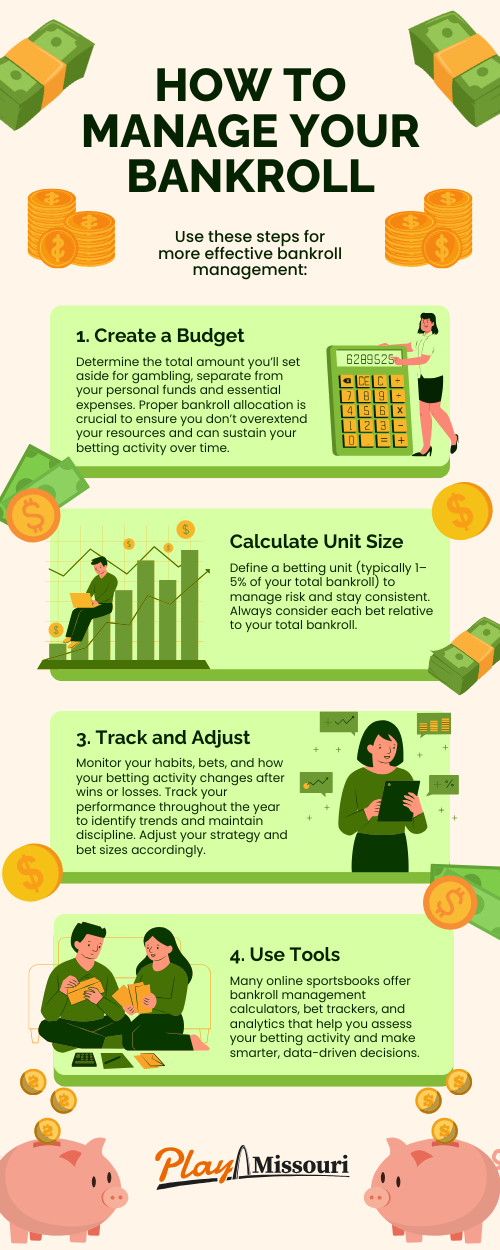
1️⃣ Set Your Dedicated Bankroll – Determine the total amount you’ll set aside exclusively for gambling, separate from your personal funds and essential expenses. Proper bankroll allocation is crucial to ensure you don’t overextend your resources and can sustain your betting activity over time. Think of it like an investment account — once funded, it should only be used for wagering, helping you stay disciplined and avoid emotional spending.
2️⃣ Calculate Your Unit Size – Establish your betting unit as a small fraction (often 1-2%, or sometimes as much as 5%) of your total bankroll for consistent wagering, protecting against the risk of losing your entire bankroll. Always consider each bet relative to your total bankroll to manage risk effectively. This steady approach keeps your losses manageable during cold streaks and lets your profits grow more steadily when you’re winning.
3️⃣ Track and Adjust – Monitor every bet and your playing habits, keeping an eye on how your betting activity changes after wins or losses. Track your performance and deposit/withdrawal patterns throughout the year to identify trends and maintain discipline. Adjust your strategy and bet sizes as your bankroll increases or decreases. Over time, your tracking data will show where you’re strongest — allowing you to focus on the most profitable markets or bet types.
4️⃣ Utilize Online Betting Tools – Many online books offer bankroll management calculators, bet trackers, and analytics features that help you stay on top of your betting activity. Use these tools to make smarter, data-driven decisions and refine your approach for better results. Limit-setting tools are also available to help you stay aware of your activity and establish responsible gambling habits.
Determining bankroll size
Setting your sports betting bankroll is step one of effective bankroll management. Start with an amount you can afford to lose, use a bankroll calculator to sanity-check the figure, and build a simple plan that protects you from losing streaks while aiming for long-term profitability.
- Use only disposable income — never rent, bills, or essentials — for your starting bankroll.
- Define a betting unit to manage risk and stay consistent.
- Right-size the bankroll to your risk tolerance so downturns don’t force bad decisions or chasing losses.
- Recalculate and adjust units as your bankroll changes (up or down) to keep risk constant.
- Consider tools/approaches (e.g., a light Kelly Criterion or flat betting) for data-driven adjustments.
- Goal: a sports betting bankroll that can absorb losing streaks, protect your initial deposit, and support steady bankroll growth over time.
Choosing a betting unit
A betting unit is a fixed fraction of your bankroll — typically 1% to 2%, or as much as 5% for advanced bettors — that sets your standard wager. Using a percentage keeps bets aligned with your bankroll as it rises or falls, helping control variance and limit drawdowns.
Example:
With a $1,000 bankroll and a 2% unit, each bet is $20. Sticking to units prevents any single loss from hurting your overall bankroll, preserves opportunities to wager, and promotes sustainable, long-term results.
Essential bankroll management strategies
Flat Betting System
The simple approach for beginners involves placing bets of the same dollar amount regardless of perceived edge. For a $1,000 starting bankroll, you might bet $20-50 per game, never adjusting based on confidence levels.
Flat betting is one of the simplest and most effective bankroll management strategies, particularly for beginners. With flat betting, you place the same amount on every play, regardless of how confident you feel about the outcome. Typically, this means betting 1-5% of your bankroll on each game. For example, if your starting bankroll is $1,000 and you choose to bet 2% per play, you would wager $20 on every game. This approach helps you manage risk by preventing significant losses and maintaining consistent betting. Flat betting is easy to follow and is a great way to build good management habits as you play, making it an ideal starting point for anyone new to wagering.

Percentage betting
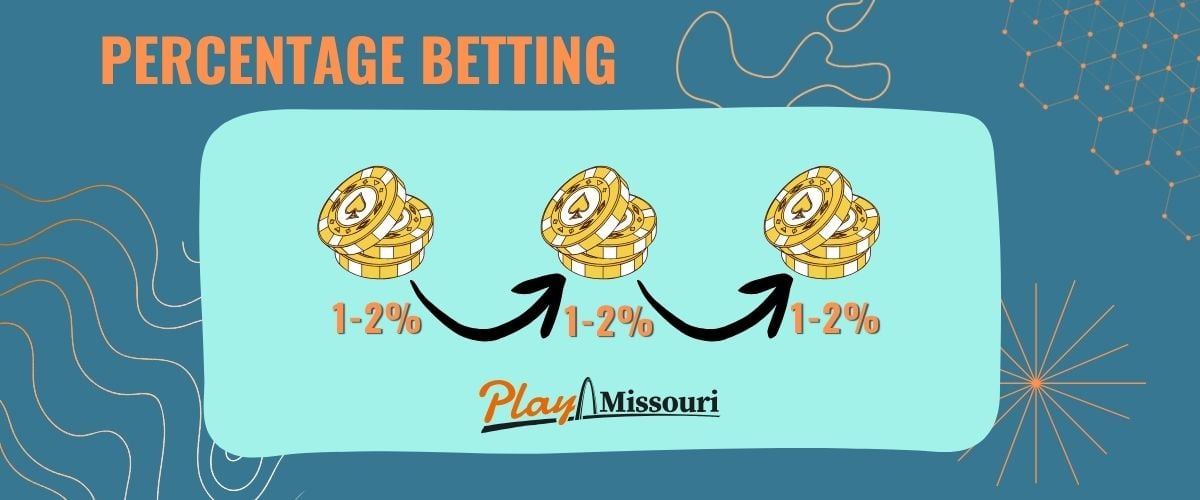
More advanced bettors risk a fixed percentage (typically 1-2%) of their current bankroll on each wager. This method enables organic bankroll growth while mitigating risk during losing periods by establishing a bankroll cap. It’s essential to track your profits over time and adjust your bankroll accordingly, ensuring that your bet sizes reflect your actual results.
Martingale betting
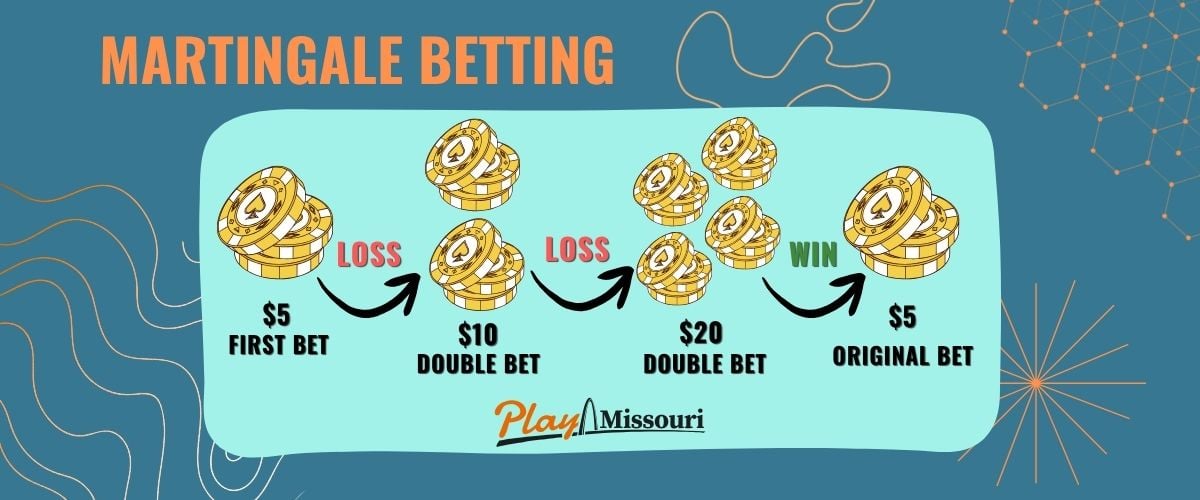
The Martingale betting system is one of the oldest and most well-known betting strategies, built around the idea of doubling your wager after every loss. The goal is to recover all previous losses and make a small profit once you eventually win. For example, if you start with a $10 bet and lose, your next bet becomes $20, then $40, and so on until you win a round. While the concept sounds simple, the risk escalates quickly — a long losing streak can drain your bankroll or hit table limits before recovery. The Martingale system works best in theory with even-money bets, but in practice, it’s a high-risk, short-term strategy that requires significant capital reserves and strict discipline.
Try our Martingale betting tool
Kelly Criterion Model
The most sophisticated formula calculates optimal bet size based on your perceived edge and implied probability. Using advanced models like the Kelly Criterion can help minimize the risk of ruin by optimizing bet sizes according to your edge and bankroll. While the Kelly Criterion approach can maximize profits, it requires an accurate assessment of probabilities and isn’t recommended for casual bettors. Many concepts and betting terms from poker, such as emotional control, avoiding tilt, and disciplined bankroll management, are directly applicable here. Successful poker players employ similar strategies to manage risk and maximize long-term gains in both poker and sports wagering.
Making data-driven adjustments is a powerful way to improve your bankroll management and overall betting performance. By consistently tracking your bets and analyzing your results, you can spot trends, identify what’s working, and find areas for improvement. This may involve adjusting your bet sizes, altering the frequency of your bets, or exploring new betting opportunities. One advanced tool that can help is the Kelly Criterion—a formula that calculates the optimal bet size based on your perceived edge and the odds. Using data and formulas like Kelly allows you to make smarter, more informed decisions, ultimately maximizing your returns and managing risk more effectively. By letting performance data guide your adjustments, you put yourself in the best position to profit over time.
Try our Kelly Criterion tool
Bet sizes and bankroll management
Choosing the right bet size is a key part of effective bankroll management. The amount you bet should be based on your initial deposit, your personal risk tolerance, and your overall betting strategy. A wise approach is to start with a small bet size — often just a small percentage of your bankroll — so you can withstand losing streaks without risking your entire bankroll.
As your bankroll grows, you can gradually increase your bet size, allowing you to take advantage of more opportunities while still managing risk. By starting small and only increasing your bets as your bankroll allows, you protect yourself from losing too much too quickly and set yourself up for long-term success.
Effective bankroll management: odds and implied probability
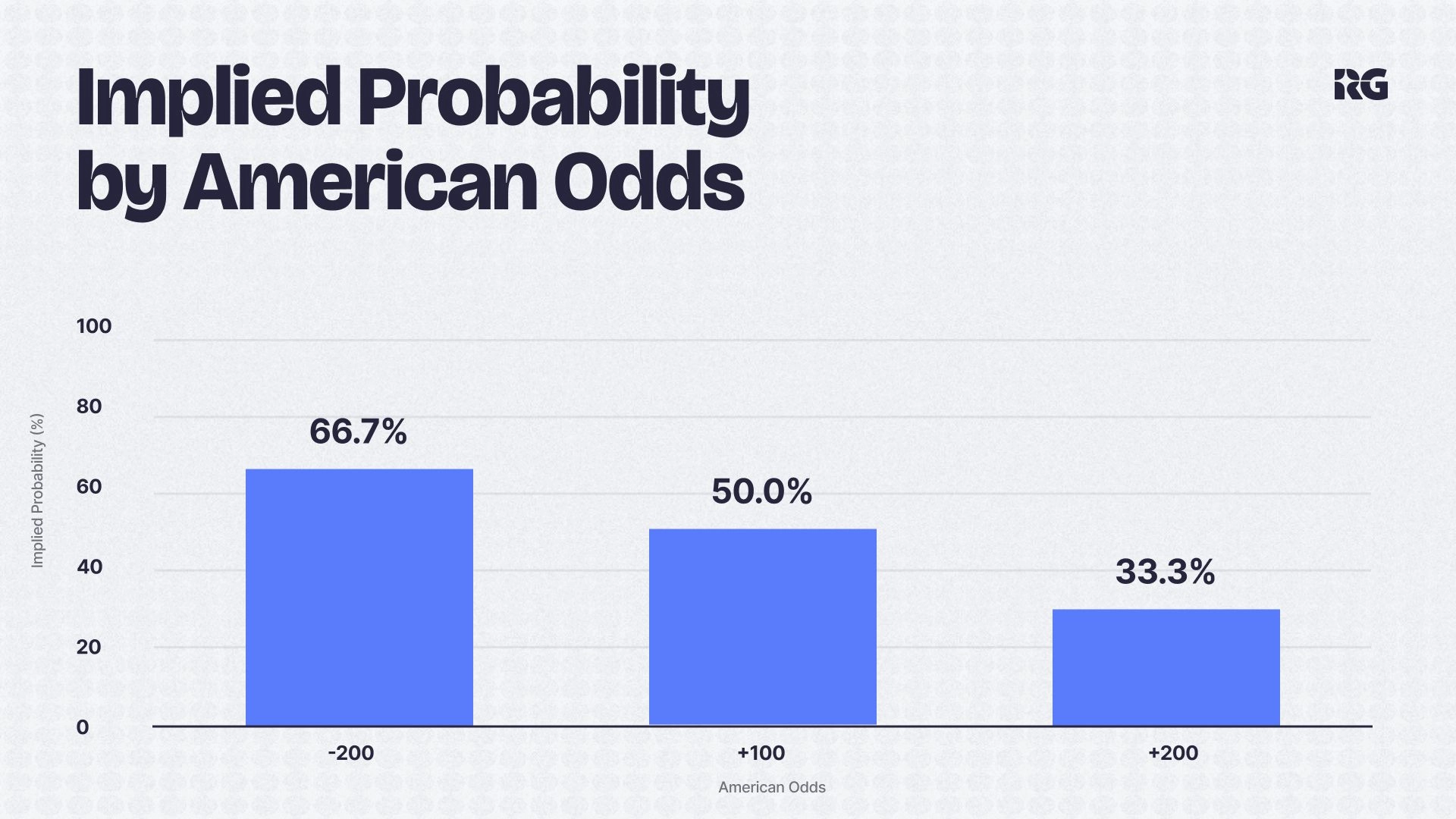
Odds and implied probability are the foundation of innovative bankroll management. Always start by converting the betting line into a percentage.
Examples:
-150 ≈ 60%
+200 ≈ 33.3%
Compare that number to your own estimated chance of winning; you only have a profitable bet when your win probability is higher than the book’s implied number.
Keep your bet sizes consistent and tied to both your edge and the level of risk you’re willing to take. A flat betting approach (using 1–2% of your bankroll per wager) is the safest default, while reducing stakes for high-variance bets helps prevent significant drawdowns. More advanced bettors can use a fractional Kelly Criterion system (such as half-Kelly) to balance growth and risk.
Always shop for better odds, as even small improvements reduce the implied probability you need to beat. Track your results, adjust your unit size as your bankroll grows, and utilize low-risk bonuses to enhance your expected value. Long-term profitability isn’t about guessing winners — it’s about disciplined staking and betting only when the numbers are in your favor.
Common bankroll management mistakes
🏃♂️➡️ Chasing Losses – Increasing bet sizes after losing streaks and making larger wagers to recover can quickly deplete your sports betting bankroll. Many bettors fail when they abandon their structured approach during emotional periods, especially when they expect luck to turn in their favor and make poor decisions as a result.
✍️ No Defined Unit System – Betting random amounts without a clear percentage or dollar figure leads to inconsistent risk management and poor long-term profitability.
📈 Poor Record Keeping – Not tracking betting performance makes it impossible to understand what’s working and prevents proper bankroll adjustments. Failing to record how much money has been lost over time can lead to further mistakes and unchecked losses.
💰 Mixing Personal and Betting Funds – Using money meant for bills or deposits when your initial bankroll runs low creates financial stress and poor decision-making. Say you’re at one of Missouri’s KC Chiefs bars, for instance, and you want to place two more wagers on the KC Chiefs than you originally planned for. Attempting to replenish your bankroll with personal funds can increase the risk of impulsive gambling and financial problems.
😞 Reason:
These mistakes happen because bettors focus on short-term results rather than long-term bankroll longevity, ultimately sabotaging their goal of sustained profit.
Bankroll changes and adaptation
Bankroll changes are a natural part of wagering, and learning to adapt your strategy as your balance rises or falls is essential. When your bankroll grows, you may choose to gradually increase your unit size to capitalize on stronger opportunities and maximize long-term gains. On the other hand, if your bankroll dips, lowering your stakes helps control risk, preserve capital, and prevent a bad stretch from becoming a full collapse. Emotional awareness matters just as much — recent wins can create overconfidence, while losses can trigger desperate chasing, both of which can undermine your strategy.
By staying disciplined, adjusting unit sizes responsibly, and keeping your decisions grounded in data rather than emotion, you ensure you’re always betting within your means. This adaptability strengthens your bankroll management, extends your longevity as a bettor, and helps you stay positioned for long-term success.

Betting performance and analysis
Want to get better at betting and turn guessing into measurable progress? The trick is to treat your bets like a small investment portfolio. Track what you bet, learn from your results, and use simple math to find out which picks actually make you money over time. The goal isn’t to win every game—it’s to make smart, consistent decisions that grow your bankroll without too much risk.
Below are simple steps to help you build a system that keeps your betting organized, smart, and repeatable.
1) Set up a simple betting tracker (spreadsheet or app)
If you only remember wins and losses, you’ll never see the full picture. A tracker helps you spot patterns — like which sports or bet types are most profitable for you.
To track your bets, create a spreadsheet (Excel, Google Sheets) or use a bet-tracking app. Create columns for:
- Date and sport (NFL, MLB, NBA, MLS, UFC, etc.)
- Type of bet (moneyline, spread, prop, parlay, etc.) and odds
- Amount wagered
- Implied probability
- Win %
- Result (win, loss, or void)
- Profit or loss
- Notes about anything that may have affected the outcome (injuries, weather, etc.)
A sample betting tracker table may look something like this:
| Date | Sport/League | Market (ML/Spread?Prop) | Pick | Odds (American and Decimal) | Stake/Unit | Implied Probability | Win % | Edge | EV per $1 | Result (W/L/Void) | Profit/Loss | Closing Odds | Closing Line Value (CLV) | Notes (Injuries, Weather, Model Change) |
|---|---|---|---|---|---|---|---|---|---|---|---|---|---|---|
| Sept. 8, 2025 | NFL | ML | Chiefs -130 vs Broncos | -130 (1.77) | 1 | 56.52% | 57.00% | 0.48% | 0.008 | W | +0.77 | -140 (1.71) | +3.21% | Broncos missing starting LT;clear weather |
| June 12, 2025 | MLB | Total O/U | Royals vs Twins Under 8.5 (-110) | -110 (1.91) | 1 | 52.38% | 54.00% | 1.62% | 0.031 | L | -1.00 | -115 (1.87) | +2.11% | Wind blowing in from CF; model tweak favored unders. |
| March 18, 2025 | NBA | Spread | Lakers -4.5 (-105) vs Suns | -105 (1.95) | 1 | 51.22% | 53.00% | 1.78% | 0.035 | W | +0.95 | -115 (1.87) | +4.43% | Suns on second night of B2B; star SG listed questionable and played limited minutes. |
2) Convert odds to implied probability — every time
Understanding how odds translate to probability is the foundation of betting analysis. Without it, you can’t tell whether the line you’re taking actually offers value.
Odds show you both how much you can win and how likely the book thinks the outcome is. Converting odds to “implied probability” helps you see if the bet is actually worth taking.
Here’s the simple idea:
- For favorites (negative odds): the implied probability is how often that team must win for you to break even
- For underdogs (positive odds): it’s the chance the book thinks they’ll win
Examples:
-110 means you need to win 52.38% of the time to break even.
+150 means you need to win 40% of the time to break even.
You only have a positive expected value (+EV) when your estimated chance of winning is higher than the implied number.
Break-even tip:
Only bet when your estimated win percentage is higher than the implied probability — that’s where long-term profit comes from.
Here’s how to convert American odds to Decimal odds and how to calculate implied probability.
Convert American odds to Decimal:
+x → 1 + (x / 100)
-x → 1 + (100 / |x|)
Calculate implied probability:
+x → 100 / (x + 100)
-x → |x| / (|x| + 100)
3) Quantify your “edge” and EV (expected value)
You can’t control outcomes, but you can measure how much value you’re buying before the game starts. Your edge is how much better you think your pick is than the odds suggest. Expected Value (EV) tells you whether your pick is worth the risk in the long run by showing how much you’d make or lose per dollar if you made the same bet hundreds of times.
You don’t need fancy math tools — just the concept:
If your chance of winning is higher than what the odds imply, you have positive EV, which means long-term profit potential. If it’s lower, you’re taking a negative EV bet, which will lose money over time. Here are some useful formulas for calculating your edge and determining your estimated value per each dollar you stake.
To calculate edge:
Your Win % − Implied Probability
Calculate EV per $1 stake:
For +x: EV = (Your Win % * x/100) − (1 − Your Win %)
For −x: EV = (Your Win % * 100/x) − (1 − Your Win %)
Example:
If you estimate 55% on a −110 favorite, your EV = 0.55*(100/110) − 0.45 ≈ +0.05 → +5% per $1 (good).
4) Track CLV (closing line value) — did you beat the market?
Consistently beating the closing line is one of the best indicators of long-term success. If your bets close at better prices than you took, this shows that your process is working and that you’re finding value before the market adjusts — even if you lose a few bets along the way.
Examples:
You bet the Royals at −110, and the odds close at −130 → you “beat the line.”
You take +150, and it closes at +130 → you got the better price.
Record the closing odds and compare them to your ticket:
- Favorites: If your price is better (closer to 0) than close (e.g., you bet −110, closes −125), you beat the market.
- Underdogs: If your plus price is higher than close (e.g., +145 ticket, closes +130), you beat it.
Optional metric:
CLV% = (Your Decimal Odds / Closing Decimal Odds − 1) × 100. Aim for positive CLV over a large sample.
5) Calculate ROI and segment it
ROI (return on investment) tells you how much profit you’ve made compared to the total money you’ve bet. Segmenting this return by sport, bet type, or book helps you see where you’re strong and where you’re bleeding value.
ROI = Total Profit ÷ Total Staked
Example:
If you’ve bet $1,000 total and made $50 profit, your ROI is 5%.
Also track:
Hit rate, average odds, avg. EV, CLV%, and variance by sport, market, stake size, and book. Performance that’s break-even but consistently positive CLV often turns profitable with time.
6) Size your bets with discipline (use your analysis)
How much you bet matters as much as what you bet. Consistent stake sizing protects your bankroll from variance and keeps emotions out of the equation. The best bettors don’t go “all in.” They bet small, consistent amounts (flat betting) — usually 1–2% of their bankroll on each play.
That means if you have $1,000, your average bet should be around $10–$20. As your bankroll grows or shrinks, adjust your bet size so your risk stays constant.
If you get more advanced, you can use strategies like the Kelly Criterion, which ties bet size to how strong your edge is. If you estimate an edge reliably, consider ½-Kelly to tie stake size to edge and odds; set a max stake cap to protect against estimation error. But keep it simple until you’re comfortable.
7) Review on a schedule and iterate
Tracking means nothing if you don’t review it. A structured weekly and monthly audit helps you refine your process and identify the markets worth your time.
Once a week, review your bets and audit mistakes (bad numbers, late injury news). Check your CLV and EV vs. realized results.
Ask yourself:
- Did you make good numbers before the odds moved?
- Were your losses due to bad luck or bad reads?
Once a month, look at the bigger picture. Cut out the ones that consistently lose. Reweight or drop markets with negative CLV/ROI, and double down on segments with sustained positive CLV and sound sample size (e.g., 200+ bets).
Ask yourself:
- Which sports, bet types, or odds ranges work best?
- What specifically drove wins/losses?
8) Build a quick dashboard
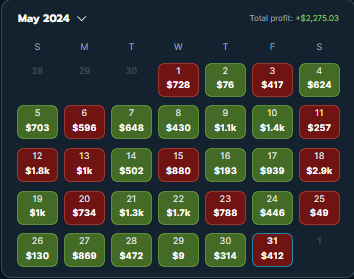
Data only helps if you can read it at a glance. A dashboard gives you instant visibility into how well your strategy is performing and turns betting from random guesses into a system you can improve every week. You don’t need software — just add summary boxes or charts in your spreadsheet.
Track:
- Total ROI
- Your best and worst sports
- Average odds
- How often you beat the closing line
Include KPIs like: “Best Sport/Market by ROI,” “Worst by CLV,” “Average EV of accepted bets,” “% Bets Beating Close,” and “ROI with/without boosts.” Track boosts separately—they alter EV.
Pro tips:
- Line shop before you bet — every 5–10 cents better on a moneyline meaningfully improves EV/ROI.
- Log voids/pushes distinctly so they don’t pollute ROI.
- Keep model confidence notes (A/B/C tiers) and compare ROI by tier—cut low-confidence tiers if they drag results.
- Treat promos as EV add-ons: note their dollar value and include it in ROI only when realized.
Do this consistently and your decisions become data-driven:
You’ll know what you beat (the close), where you win (segments), and how to size bets to grow the roll without blowing it up.
Bottom line:
You can’t control every game, but you can control your process. Tracking your bets, understanding value, and sticking to smart bankroll rules will help you think like a pro—even if you’re just starting out. Over time, you’ll learn which bets are truly worth your money and which ones are just noise.
| Date | Site | Sport/League | Game | Wager | Odds | Boost? | Bet | W/L | Profit/Loss | Site Balance (EOD) |
|---|---|---|---|---|---|---|---|---|---|---|
| Sept. 29, 2025 | bet365 | NFL | CIN-CAR | o47.0 (-110) | -110 | N | $5.50 | W | $5.00 | -- |
| bet365 | NFL | KC-LAC | o37.5 (+100), live | +100 | N | $10.00 | L | -$10.00 | -- | |
| bet365 | NFL | BAL-BUF | SGP: BAL -0.5 1H (-110); BUF +0.5 2H (-110) | +275 | N | $10.00 | L | -$10.00 | $114.70 | |
| Sept. 30, 2025 | FanDuel | NFL | SEA-DET | Each team TD both halves | +2300 | N | $5 (bonus bet) | L | $0.00 | -- |
| FanDuel | NFL | SEA-DET | o46.5 | +109 | Y | $5.00 | W | $5.45 | $108.70 | |
| Oct. 1, 2025 | ESPN Bet | MLB | DET-HOU, NYM-MIL | PAR: DET ML (+125); NYM ML | +528 | Y | $5.00 | W | $26.40 | $80.76 |
| Oct. 2, 2025 | DraftKings | MLB | HOU-DET | HOU ML, live | +130 | N | -$5.00 | L | -$5.00 | $272.28 |
| FanDuel | MLB | KC-BAL | KC ML | +124 | N | $10 (bonus bet) | W | $12.40 | $121.10 | |
| Caesars | MLB | NYM-MIL | SGP: NYM ML (+100); o7.5 (-115); Vientos o1.5 tb (+139) | +532 | Y | $5.00 | L | -$5.00 | $174.71 | |
| ESPN Bet | MLB | SD-ATL | SD -0.5 F5 | +115 | N | $5.00 | W | $5.75 | $86.51 | |
| Oct. 3, 2025 | ESPN Bet | MLB | NYM-MIL | SGP: NYM ML (+110); Quintana o4.5 K's (+140); Lindor o1.5 tb (+100) | +538 | N | $5.00 | W | $26.51 | -- |
| ESPN Bet | MLB | NYM-MIL | Quintana o4.5 K's | +145 | N | $5.00 | W | $7.25 | $120.67 | |
| FanDuel | NFL | TB-ATL | SGP: Godwin 1 rec. 6th drive; Evans 1 rec. 6th drive; Otten 1 rec. 6th drive, live | +1078 | N | $5.00 | L | -$5.00 | $116.10 | |
| DraftKings | NFL | TB-ATL | Koo o1.5 FG | -140 | N | $7.00 | W | $277.28 | ||
| Caesars | NFL | 9 games | 9-leg PAR (kickers o1.5 FG) | +20030 | N | $5.00 | L | -$5.00 | $169.71 | |
| Oct. 5, 2025 | FanDuel | MLB | PHI-NYM | PHI -1.5 | +125 | N | $10.00 | L | -$10.00 | $106.10 |
| Oct. 6, 2025 | bet365 | MLB | NYM-PHI | SGP: u4.5 F5 (-140); o7.5 (-125) | +450 | N | $5.00 | W | $13.34 (early cashout) | $128.04 |
| Caesars | NFL | DAL-PIT | SGP: Aubrey o1.5 FG (-135); Boswell o1.5 FG (-115) | +240 | N | $5.00 | L | -$5.00 | $164.71 | |
| Oct. 8, 2025 | Fanatics | WNBA | CON-MIN | o37.5 3Q, live | -110 | N | $5.00 | L | -$5.00 | $64.00 |
Online casino bankroll management and online poker bankroll management
While this guide primarily focuses on sports betting bankroll management, the principles of effective bankroll control apply equally to Missouri online casino games and poker. A ‘session bankroll’ refers to the specific amount of money you allocate for a single casino or poker session, helping you manage risk and avoid losing your entire bankroll in one sitting. Managing your funds responsibly in these environments is crucial to maintaining longevity and maximizing your chances of success.
Casino bankroll management
Casino bankroll management involves setting aside a specific amount of money exclusively for playing casino games, such as slots, blackjack, or roulette. Just like with sports betting bankroll management, the key is to only use money you can afford to lose and to divide your bankroll into smaller units for each session or bet.
For example, in bankroll management blackjack strategies, players often recommend betting a fixed percentage of their casino bankroll per hand to protect against losing streaks and reduce volatility. By sticking to disciplined bet sizing and avoiding chasing losses, you can enjoy casino gaming while preserving your bankroll over time.
Bankroll management poker
Poker bankroll management is essential for both recreational and professional players. Poker involves a significant element of skill, but variance can still lead to extended losing streaks. Proper bankroll management poker strategies advise players to maintain a bankroll large enough to withstand downswings, typically measured in multiple buy-ins for the stakes you play.
This approach helps prevent going broke during inevitable swings and allows you to move up in stakes responsibly as your bankroll grows. Tracking your poker session results and adjusting your bankroll size accordingly mirrors the best practices found in sports betting bankroll management, promoting long-term profitability and minimizing risk.
By applying these gambling bankroll management principles while gambling, you create a consistent framework that fosters responsible gambling and helps you manage risk effectively across all your betting activities.
What successful bettors say
⭐️⭐️⭐️⭐️⭐️ Edward O. Thorp (Kelly Criterion pioneer)
“A characteristic of the Kelly criterion is that … the optimal fraction … may become ‘large.’” Thorp cautions that full-Kelly maximizes long-run growth but comes with big volatility and drawdown risk; many gamblers therefore use fractional Kelly to tame swings while preserving most of the growth edge.”
⭐️⭐️⭐️⭐️⭐️ Billy Walters (legendary sports bettor)
“You shouldn’t be betting more than one to three percent of your bankroll on any bet.” Walters adds that patience, price shopping, and avoiding emotional decisions matter as much as picks—your edge compounds only if you protect your stake.”
⭐️⭐️⭐️⭐️⭐️ Jack Andrews (pro bettor; Unabated co-founder)
“Proper bankroll management won’t turn a losing bettor into a winning bettor, but it could turn a winning bettor into a losing bettor.” His point: staking errors (overbetting your edge, ignoring variance) ruin good bettors; many pros either flat-bet small or use fractional Kelly to survive cold streaks.”
⭐️⭐️⭐️⭐️⭐️ Ed Miller (co-author, The Logic of Sports Betting)
“Gambling is about finding people who are willing to lose to you.” Miller’s larger message: learn to identify weak markets, convert odds to break-even percentages, and get the best price—edge first, then size your bets sensibly.”
⭐️⭐️⭐️⭐️⭐️ Rufus Peabody (pro bettor; Unabated)
“Good bankroll management won’t make you a winning bettor. But bad bankroll management could wipe you out.” Peabody urges bettors to measure bet quality (e.g., CLV, expected ROI), keep stakes conservative, and focus on repeatable +EV processes over short-term results.”
Start managing your bankroll today
Understanding bankroll management is the key difference between successful sports bettors and those who lose money over time. The most important practice you can start today is calculating your betting unit size and committing to never exceeding it, regardless of how confident you feel about any single wager.
Take your total betting funds, figure out your risk tolerance, and begin with flat betting or percentage betting basics. Remember: protecting your bankroll is more important than any individual victory.
Leverage the best online betting platforms to access a wide range of sports markets, competitive odds, and generous bonuses. These tools, combined with solid bankroll management, can elevate your betting experience and boost your chances of success. Put your bankroll management skills to work and set yourself up for success with these sports betting bankroll management strategies.
